Surface-roughened Silver Wires with Uniformly Distributed Plasmonic Hotspots for SERS Applications
We developed surface-roughened Ag wires with a characteristic of uniformly distributed plasmonic elements of size 30 to 100 nm for enabling highly sensitive SERS applications. The closely spaced nanostructures on Ag wire surface significantly enhanced the light-matter interaction above a wavelength of 550 nm, indicating the formation of plasmonic hotspots due to the inter-particle plasmon coupling. They were successfully utilized as SERS based sensor platforms to attain a low detection level of 1 nM with an enhancement factor, EF up to 10^8 for methylene blue molecules.

Nanoscale Roughened Ag Wires with Spatially Extended Plasmonic Hotspots
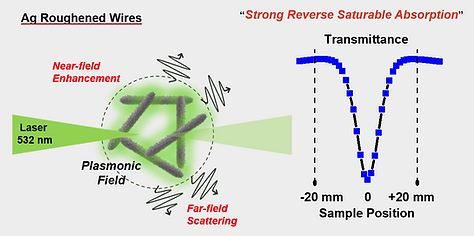
Herein, we developed Ag wires (AgWs) with roughened nanostructures on surface with a size less than 100 nm to maximize the plasmonic effect formation toward enhancement in nonlinear optical responses. The plasmon resonance induced near-field effects provided an effective nonlinear absorption coefficient, βeff of 48.00 cm/GW at an input pulse energy of 30 µJ, when these surface roughened Ag wires (SR-AgWs) were evaluated using an open aperture Z-scan technique with Nd:YAG nanosecond laser pulses of wavelength of 532 nm, pulse width of 7 ns, and repetition rate of 10 Hz. This βeff value was found to be 92% higher than the pristine AgW at the same input pulse energy, indicating the importance of plasmonic hotspots in nonlinear optical activity.
Plasmon-Induced Nonlinear Optical Response of PTCDI-C8 Nanoribbons Doped with Au Nanoparticles
1D nanostructures of N,N′-Dioctyl-3,4,9,10-perylenedicarboximide (PTCDI-C8) were developed to investigate the NLO responses. The plasmonic Au nanoparticles were synthesized and integrated with these PTCDI-C8 nanoribbons to attain the hybridized optical characteristics. This work aims for a novel way to achieve superior NLO responses by synergistically combining the surface plasmon oscillations of Au NPs with the excitonic transition of PTCDI-C8 nanoribbons. Theoretical studies based on finite-difference time-domain (FDTD) simulations were also carried out in detail to monitor the light-matter interaction with Au-PTCDI-C8 nanohybrid systems.

Plasmon Enhanced Optical Nonlinearity of Au-WS2 Nanohybrids

Nonlinear optical properties of Au-WS2 nanohybrids were studied using the open aperture Z-scan technique with nanosecond laser pulses of wavelength 532 nm, which lie in the plasmonic band of Au NPs (480–550 nm) and B-excitonic transition range of WS2 nanosheets (520–535 nm). Au–WS2 nanohybrids exhibited an enhanced nonlinear absorption and optical limiting activity with an effective nonlinear absorption coefficient of 182 cm/GW at an on-axis input intensity of 0.14 GW/cm2, which is 3.87 times higher than that of bare WS2 nanosheets.
Linearly Polarized Emission from One Dimensional Organic Semiconductor Microstructures
Linearly polarized emission was observed from a crystalline 1D PTCDI-C8 microstructure. Rotating microscopy imaging of this structure under crossed polarization was performed for the investigation of polarized emission. The anisotropy birefringence was maximum only when the 1D microstructure was aligned 45 degrees to the direction of the polarizer, and it was minimum when aligned parallel to the polarizer.

Nonlinear Optical Properties of Few layer Transition Metal Dichalcogenide Nanoflakes

Open aperture Z scan analysis of both the MoS2 and WS2 nanoflakes using 532 nm nanosecond laser pulses reveals strong nonlinear absorption activity with effective nonlinear absorption coefficient of 120 cm/GW and 180 cm/GW, respectively, which was attributed to the combined contributions of ground, singlet excited and triplet excited state absorption. Optical limiting threshold values of MoS2 and WS2 nanoflakes were obtained as ~ 1.96 J/cm2 and 0.88 J/cm2, respectively, which is better than many of the reported values.
Plasmon Assisted Light Propagation in Chemically Synthesized Silver Nanowires
Around 15-micrometer length Ag nanowires were chemically synthesized using the Polyole method. The waveguiding capability of these nanowires was investigated by irradiating the nanowire at one end using a laser beam. The surface plasmon polariton-assisted light propagation of more than 15 micrometers was successfully demonstrated using this experiment. These results suggest the subwavelength light propagation ability of synthesized Ag nanowires.
